
Contractors have spent the last several years adjusting to higher material costs, labor shortages, changing consumer demand and a housing market that never quite returned to normal.
Now interest rates are moving higher again.
In September, the Federal Reserve raised its benchmark interest rate by a quarter point to a target range of 3.75% to 4%. The Fed’s latest projections also suggest rates could move higher again before the end of the year as policymakers continue working to bring inflation under control.
That doesn’t mean homeowners are going to stop replacing roofs, windows, doors or other products their homes need. It does mean contractors should prepare for a market where customers may be more selective, financing remains expensive and the next job may be harder to win.
In that environment, protecting margin becomes even more important.
Higher Rates Add Pressure to an Already Complicated Market
The federal funds rate isn’t the same thing as a mortgage rate or the financing rate offered to a homeowner. But higher interest rates can work their way through the economy by making borrowing more expensive for consumers and businesses.
For contractors, that pressure can show up in several places.
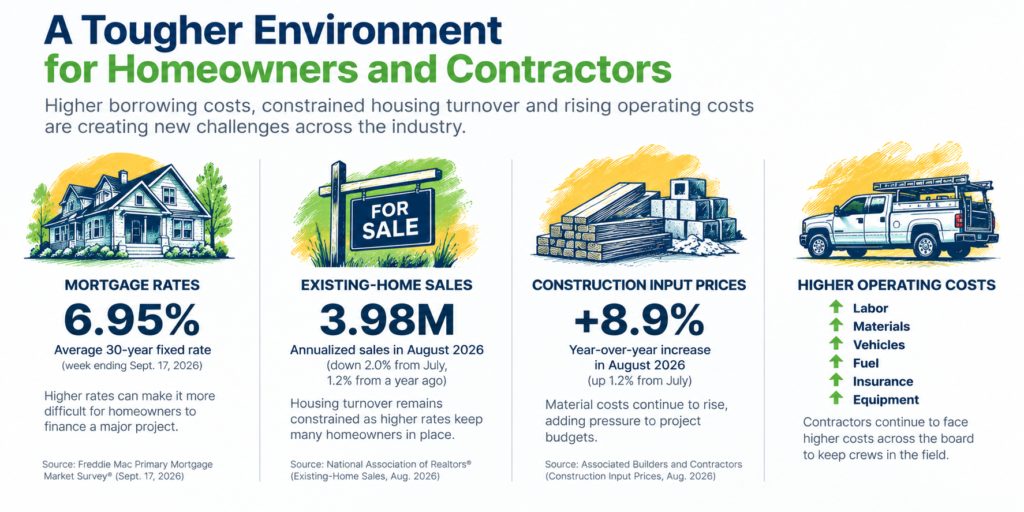
Homeowners may think harder about financing a major project. Businesses face higher borrowing costs. Housing turnover can remain constrained. And contractors still have to contend with the cost of labor, materials, vehicles, fuel and everything else required to put a crew in the field.
The National Association of Home Builders reported in September that higher mortgage rates, labor shortages and material costs were weighing on builder confidence. Buyer traffic also weakened across much of the country.
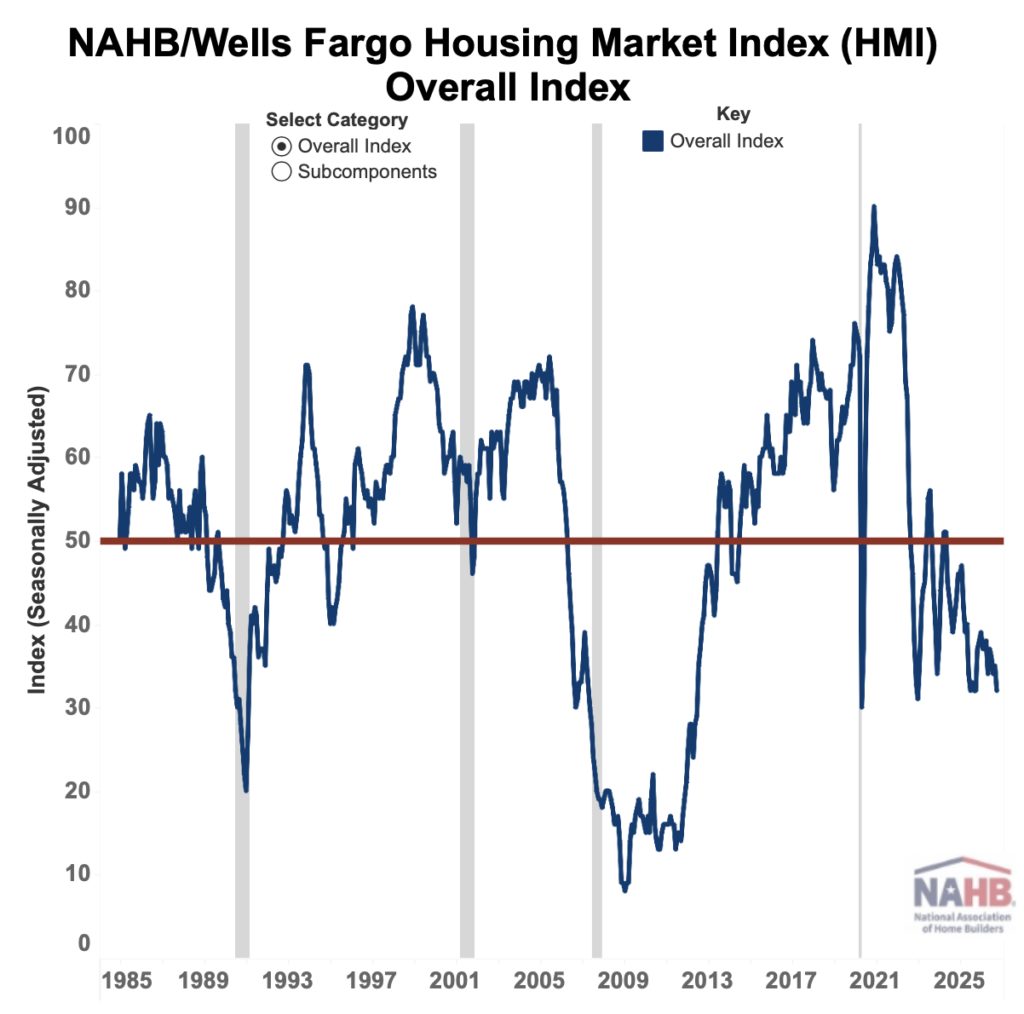
Builder Confidence since 1985
But this isn’t a story about demand disappearing.
Home Depot reported a 1.3% increase in U.S. comparable sales during its second quarter, while Lowe’s reported continued strength in Pro and Home Services even as discretionary DIY spending remained under pressure.
Homeowners are still spending money on their homes. The question is where, when and how carefully.
Necessary Work Doesn’t Stop Because Interest Rates Go Up
A homeowner may postpone a cosmetic upgrade. It’s harder to postpone a leaking roof, damaged door or another problem that affects the safety, comfort or function of the home.
That’s an important distinction for contractors working in replacement and installed sales.
Higher rates can make discretionary spending more difficult, but America’s homes continue to age and require work. Homeowners who decide not to move still have houses to maintain.
That creates an unusual market for contractors.

There may be plenty of work available, but contractors can’t assume growth will come simply from putting more leads into the top of the funnel.
They have to get more value from the opportunities they already have.
When the Next Job Is Harder to Win, the Current Job Matters More
Every sold project represents an investment.
Money was spent generating the lead. Someone followed up. A salesperson visited the home or worked with the customer. Measurements may have been taken. Financing may have been arranged. Materials have to be ordered. A crew has to be assigned.
By the time a project enters production, the contractor has already invested significant time and money into winning it.
That’s why production problems become particularly expensive when demand gets tighter.
A scheduling mistake can create another truck roll. Poor routing wastes labor and fuel. A missed measurement delays the project. A bad handoff generates callbacks. Installation errors create rework. Long delays can lead to cancellations and unhappy customers.
Each problem chips away at the value of a job the company already worked hard to win.
In a market where the next job may be harder to win, contractors can’t afford to lose margin on the work they’ve already sold.
Margin Isn’t Only Determined by What You Charge
Contractors naturally think about margin in terms of selling price, labor and material costs.
But production has a major influence on what remains when the job is finished.
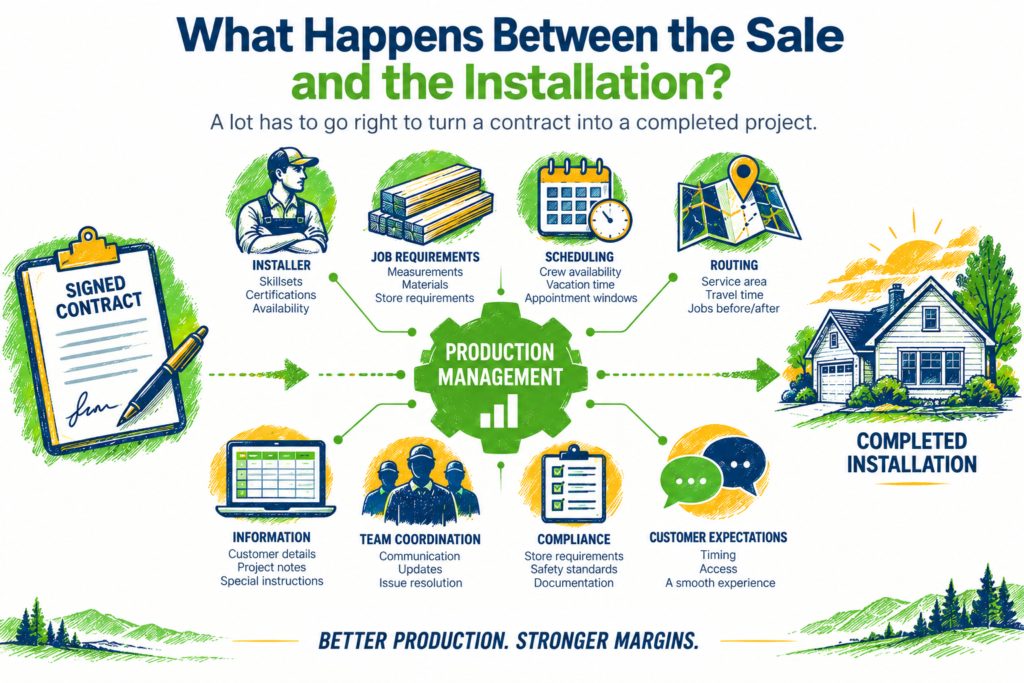
Consider how many decisions have to happen between a signed contract and a completed installation.
The right installer has to be assigned. Certifications and skillsets have to match the job. Store requirements have to be considered. Crews need to be routed efficiently. Vacation schedules and availability have to be accounted for. Materials, measurements and customer expectations all have to line up.
When those decisions depend on spreadsheets, disconnected systems or knowledge stored in the heads of a few experienced employees, growth becomes increasingly difficult to manage.
The alternative isn’t simply hiring more people to keep track of everything.
It’s using better production management to help your existing team handle more work without adding more overhead.
How Many Installations Can Your Existing Team Manage?
That may become one of the most important questions contractors ask heading into the end of 2026.
Adding revenue traditionally means adding resources. More jobs require more coordinators. More installers require more schedulers. More markets require more managers.
But additional headcount adds cost before it adds capacity.
Production management offers another path.
A production management system can use the information already surrounding a project to help determine what needs to happen next.
Scheduling can account for installer skillsets, certifications, service areas, store assignments, crew availability, travel distances and other requirements that experienced schedulers traditionally have to remember themselves. Information can move with the project instead of being repeatedly entered, emailed, searched for or handed from one person to another.
The goal is straightforward:
Increase the number of installations your existing team can manage without allowing service or quality to suffer.
That creates capacity without automatically creating another layer of overhead.
Production Management Becomes a Margin Strategy
No contractor can control what the Federal Reserve does next.
You can’t control mortgage rates, consumer confidence or whether a homeowner decides to move, remodel or wait another year.
But once a customer says yes, much more is within your control.
How quickly a project moves into production, how efficiently crews are scheduled and routed, and how much administrative work is required all affect the profitability of the job. Delays, unnecessary travel and time spent tracking down information create costs that continue adding up until the installation is complete.
Every one of these operational decisions has a direct impact on your margins.
Production management helps contractors protect the value of the sale after the contract is signed.
Make More of the Work You’ve Already Won
The remainder of 2026 doesn’t necessarily point toward a collapse in contractor demand. The Federal Reserve still describes economic activity as expanding at a solid pace, even as inflation remains elevated.
But contractors shouldn’t mistake continued demand for easy growth.
Customers have reasons to be more selective. Financing remains a consideration. Costs remain important. And every unnecessary expense between the sale and installation puts additional pressure on margin.
That makes the production side of the business increasingly important.
Getting more from the work you’ve already sold can mean more completed projects, better use of your existing capacity and more margin retained at the end of every job.
That’s what production management is built to do.
Protect More of the Margin You’ve Already Earned
Winning the job is only the beginning. Cilio helps contractors manage what happens after the sale, from measurements and scheduling to installation and completion, so teams can handle more work while reducing the delays, mistakes and unnecessary costs that eat into margin.
Schedule a quick call or demo to see how Cilio can help you get more value from every job you sell.